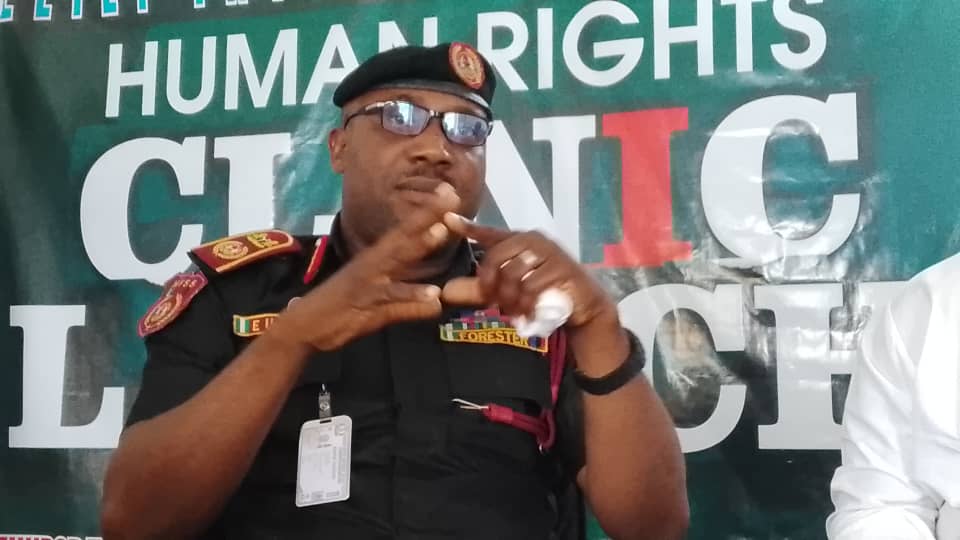
The Commander of the Nigeria Forest Security Service (NFSS), Rivers State Command, Ambassador Dr George Esene, has denied allegations that he expressed hatred towards the Ikwerre people, describing a viral social media video at the centre of the controversy as misleading and taken out of context.
Esene made the clarification during a press briefing organised by Relief International Africa Human Rights Clinic and Civil-Military Police, Paramilitary Relations (CIMPARR-Nigeria), in Port Harcourt on Tuesday, October 13, 2026.
He explained that the video originated from an informal discussion with friends and colleagues several months ago, insisting that he never expressed hatred or hostility towards the Ikwerre ethnic group or any other community.
The commander said he was shocked to see the video circulating on social media, adding that his family ties and longstanding relationship with the Ikwerre people contradicted the allegations.
He disclosed that he had lived in Ikwerre land for about seven years and that several Ikwerre indigenes occupied key positions within the NFSS Rivers State Command, including his personal assistant, public relations officer and secretary.
“Who am I to hate the Ikwerre people?” he asked, maintaining that his professional relationships had always been guided by duty, fairness and cooperation rather than ethnic considerations.
Esene alleged that the controversy might be connected to personal interests and individuals seeking to undermine his leadership or take over his position. He, however, urged the public not to allow the allegations to create ethnic divisions or damage the relationship between the security service and the communities it serves.
Explaining the importance of community cooperation in security operations, he said the NFSS relied on traditional rulers and community members for local intelligence gathering. He noted that traditional rulers from Ikwerre communities served as patrons of the organisation and that the service maintained working relationships with communities across Rivers State.
The commander, who said he had spent one year and seven months in the position, added that he had encouraged community representation within the organisation to strengthen local participation and improve security collaboration.
He warned that the controversy could undermine public confidence in the service and affect its operations, particularly in communities where trust and cooperation are essential to effective security delivery.
Esene appealed to residents, particularly members of the Ikwerre ethnic group, to remain calm and avoid drawing conclusions without considering the full context of the video. He reaffirmed his commitment to serving all communities in Rivers State without ethnic discrimination.
Meanwhile, the Executive Director of Relief International Africa Human Rights Clinic and Coordinator of CIMPARR-Nigeria, Isaac Green, commended Esene for engaging with the organisation to explain his position on the controversy.
Green described the engagement as a positive step towards dialogue and clarification, stressing that allegations involving public officials should be approached with fairness and restraint.
He said the organisation had taken note of the viral video and the allegations against the commander but urged the public to distinguish between claims and independently established facts.
According to Green, public office holders must exercise caution when discussing ethnic groups and other sensitive issues, as informal conversations can acquire wider significance when extracted from their original context and circulated on social media.
He also called on social media users to verify information before sharing it, warning that unverified allegations could damage reputations and inflame communal tensions.
Green emphasised that while citizens had the right to raise legitimate concerns about public officials, those accused of wrongdoing deserved a fair opportunity to respond.
He urged community leaders, stakeholders and residents to avoid using the controversy to promote ethnic hostility or division, stressing that peaceful coexistence among Rivers State’s diverse communities was essential to the state’s security, stability and development.
The organisation called for responsible public discourse, mutual understanding and constructive engagement among stakeholders as the controversy unfolds.
The Chairman of the Rivers Indigenous NGOs and Civil Society Network (RINGOCS), Tombari Dumka-Kote, condemned the viral video involving the Commander of the NFSS, Dr George Esene, describing it as a cybercrime while calling for its immediate removal from social media.
Dumka-Kote said the circulation of the video, which Esene alleged had been edited, could undermine the fragile peace in Rivers State and damage the image of the security agency and the state.
He acknowledged the importance of public accountability, noting that citizens had the right to demand explanations from heads of security agencies and government institutions. However, he said such demands should be pursued through carefully considered approaches that would not create further tension.
According to him, preliminary findings indicated that Kelvin Nwanwa, who circulated the video, had neither formally written to the service nor approached the commander to seek clarification on the allegations surrounding the footage.
Dumka-Kote argued that editing and circulating the video in a manner capable of discrediting the security agency was inappropriate, particularly at a time when the state was dealing with political tensions and fragile peace.
He urged Nwanwa to immediately take down the video and ensure its removal from further circulation.
The RINGOCS chairman warned that the continued circulation of the footage could go beyond tarnishing the image of the NFSS to affect the reputation of Rivers State and its people.
He called on stakeholders to exercise restraint and adopt responsible approaches to addressing concerns involving security agencies, stressing the need to protect the state’s peace and stability.