
Governorship candidates in the 2027 Rivers State election have outlined their proposed policies and commitments in response to a Citizens’ Charter of Demands presented by residents during a governorship dialogue in Port Harcourt.
The charter seeks four years of measurable progress, economic fairness, social justice, transparent leadership and accountable governance, insisting that the people must remain at the centre of government policies and development.
The demands were presented during the Rivers We Want Town Hall Series – RIVERS 2027 GOVERNORSHIP DIALOGUE, themed The People’s Agenda, held on Friday, October 30, in Port Harcourt.
The dialogue was convened by the Rivers Peace Initiative in partnership with Super 93.3 FM, the Centre for Peace and Security Studies, University of Port Harcourt, the Trade Union Congress (TUC), Rivers State, and other stakeholders.
Speaking at the event, Convener of the Rivers Peace Initiative, Obinna Ebogidi, said the people were demanding leadership that listens, institutions that serve, public resources that benefit citizens and development that reaches every community.



He said the Citizens’ Charter of Demands was designed to provide a common framework for discussing candidates’ promises, securing commitments and assessing their performance in office.
According to him, the demands cover affordable housing, accessible healthcare, reliable electricity, safe roads, environmental protection, security, decent employment, fair taxation, workers’ welfare and the dignity of retirees.
Ebogidi urged governorship candidates to publicly adopt the charter, translate its demands into realistic four-year programmes, allocate resources to agreed priorities and submit themselves to regular public accountability.
He stressed that although four years might not be enough to resolve all the structural challenges facing the state, no administration should use such challenges as an excuse for inaction, secrecy, waste or neglect.
He also called on residents to remain actively involved in governance beyond election periods, noting that democracy required citizens to ask questions, demand accountability and participate peacefully.
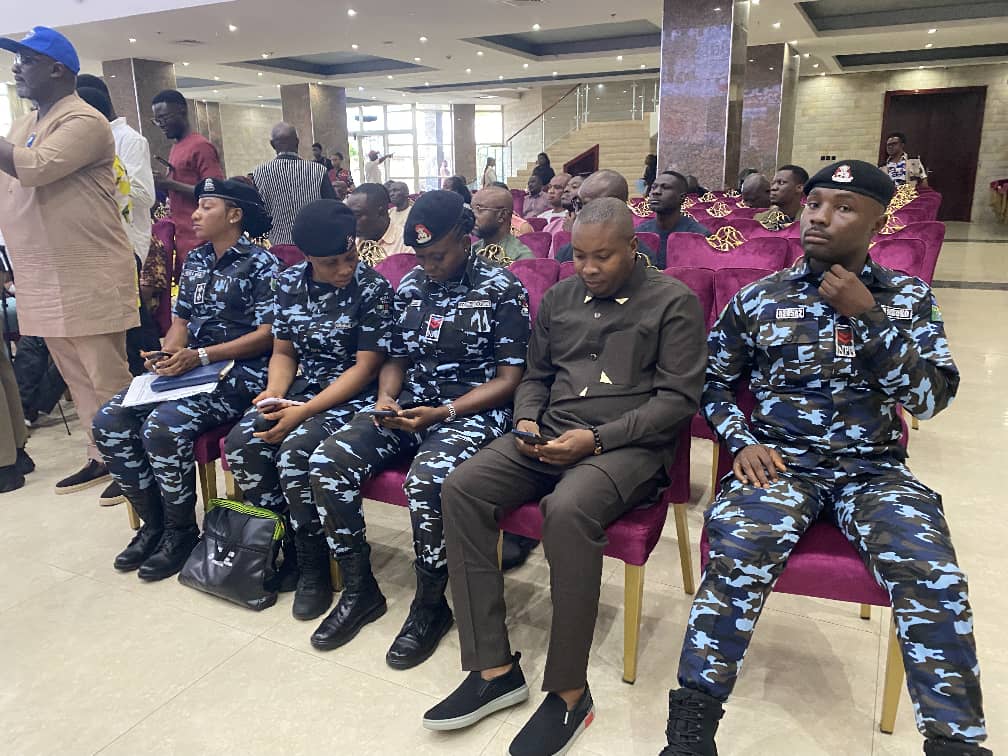
In her remarks, the spokesperson for the Rivers State Police Command, ASP Blessing Karbolo, urged political leaders, candidates and their supporters to prioritise peace, tolerance and responsible conduct ahead of the 2027 elections.
She warned youths against allowing themselves to be used for political violence, thuggery and electoral malpractice, while encouraging eligible voters to reject vote-buying, hate speech and the spread of inflammatory information.
Karbolo also called on political stakeholders and residents to cooperate with security agencies, obey lawful directives and promptly report suspicious activities.
She emphasised that political differences should not undermine peaceful coexistence, urging Rivers people to choose peace over violence and unity over division.
Responding to the charter, the African Democratic Congress (ADC) governorship candidate, Dr Gabriel Pidomson, identified unemployment, poverty and insecurity as major challenges requiring urgent attention.
Pidomson said his administration, if elected, would address the concerns through investments in education, agriculture, environmental restoration, infrastructure, affordable housing, healthcare, industrialisation and employment.
He promised to publish an implementation roadmap within his first 100 days, outlining government priorities, responsible institutions, funding requirements and measurable targets.
The ADC candidate also pledged equitable development across the state’s 23 local government areas, regular town hall meetings and annual performance reports detailing government achievements and expenditure.
He proposed monthly engagements with residents through what he described as the People’s Parliament, where citizens would have opportunities to question the governor and assess government performance.
Pidomson further promised to introduce legislation to institutionalise the Rivers People’s Charter and establish an independent, citizen-led committee to monitor its implementation.
On security, he described insecurity as a major obstacle to economic development, arguing that businesses and investors would struggle to thrive without safe communities.
He proposed legislation on street naming, house numbering and occupancy registration within his first 100 days, saying the exercise would improve security planning, emergency response, infrastructure development and public service delivery.
He also promised reforms in the civil service, particularly in the treatment of retiring workers, including early retirement planning, proper documentation and improved pension administration.
Similarly, the African Action Congress (AAC) governorship candidate, Ivy West, pledged to sign the Citizens’ Charter and publish annual reports on her administration’s performance if elected.
West said her manifesto was anchored on 12 pillars aligned with the Sustainable Development Goals, covering peace and security, employment, women’s empowerment, youth development, education, healthcare, elderly care, climate change, renewable energy, agriculture, housing and accountable governance.
She outlined several commitments for her first 100 days in office, including a comprehensive audit of state finances and contracts and the appointment of a cabinet with at least 35 per cent women.
Other promises included a community security framework, a peace hotline, an emergency response to unemployment, skills development programmes and free maternity and elderly care services in primary healthcare centres across the 23 local government areas.
She also pledged to publish a timetable for clearing outstanding pension and salary arrears and present a people’s budget following town hall consultations across the three senatorial districts.
Meanwhile, the National Rescue Movement (NRM) governorship candidate, Reverend Minaibim Harry, promised to unite the state and address security challenges as part of his administration’s priorities.
Harry said he would adopt a state security system to tackle insecurity, while also pursuing economic expansion and development if elected.
He expressed optimism that Rivers State could achieve greater peace and prosperity through improved security and effective governance.
The governorship candidate of the Social Democratic Party (SDP), Prof. Ben-Gurion Peter, pledged to end godfatherism and politics of personal interest in Rivers State if elected governor in 2027.
Peter said his administration would prioritise the interests of the people, ensure equitable distribution of resources and create opportunities for residents, irrespective of their ethnic backgrounds.
Also, governorship candidate of the Peoples Redemption Party (PRP), Chief Nature Kieghe, identified drug abuse among youths as a major factor contributing to insecurity, violence and criminality in Rivers State.
Kieghe said his administration would prioritise rehabilitation, skills development and human capacity building to address the problem. He drew from his experience with the Youth Rescue International Development Organisation, where he said thousands of young people had been rehabilitated from drug addiction, violence and criminal activities.
Kieghe further pledged to provide loans for skills acquisition, particularly in agriculture, describing the sector as a major avenue for employment creation through production, processing, packaging and export.
He proposed reducing tuition fees in state-owned tertiary institutions to a maximum of N80,000, promising to sanction any institution head who failed to implement the policy. The PRP candidate also pledged to grow the state’s internally generated revenue to over N300 billion monthly, while prioritising workers’ welfare, payment of salaries and pensions.
Our correspondent reports that five governorship candidates were present at the dialogue, including representatives of the African Democratic Congress (ADC), National Rescue Movement (NRM), African Action Congress (AAC), Social Democratic Party (SDP) and Peoples Redemption Party (PRP).