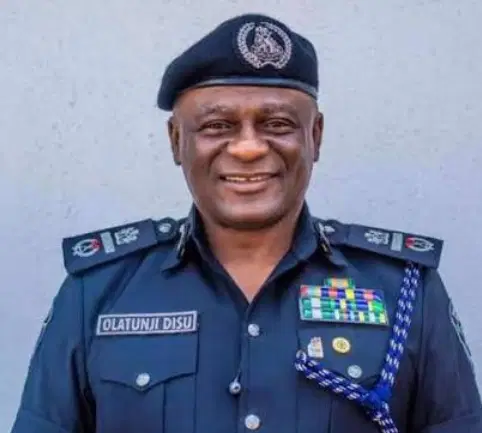
When IGP Olatunji Disu assumed office as the 23rd indigenous Inspector-General of Police on February 25, 2026, he pledged not to squander the confidence reposed in him.
Eight months into his tenure, that pledge is being measured against the realities of policing Nigeria, the crimes confronted, reforms pursued, officers disciplined and the continuing effort to rebuild public confidence in the Nigeria Police Force.
Disu inherited a Force grappling with longstanding challenges, including crime prevention, public trust, internal discipline and operational effectiveness.
Since taking charge, his administration has sought to reposition policing around intelligence-led operations, internal accountability, tactical restructuring and stronger engagement with communities.
A career police officer with extensive operational experience, Disu previously served as Assistant Inspector-General of Police at the Force Criminal Investigation Department Annex, Alagbon, Lagos. He also commanded the Lagos Rapid Response Squad from 2015 to 2021, served as Commissioner of Police in Rivers State and the Federal Capital Territory, and headed anti-kidnapping and anti-robbery operations in different parts of the country.
He also led Nigeria’s first police contingent to the African Union Mission in Sudan in 2005 and holds a third-degree black belt in judo.
From command rooms to the streets, the months since his appointment have offered an indication of the direction of his administration.
But beyond arrests, recoveries and operational figures, a fundamental question remains: how much has changed in the daily relationship between the police and the people they are sworn to protect?
State Police Question
Barely a week after assuming office, Disu signalled his intention to engage one of the most consequential issues in Nigeria’s policing debate.
On March 4, 2026, he inaugurated a committee on the implementation of state police, charging it with examining policing models, community security needs and the framework required for establishing state police.
The committee was also mandated to consider recruitment, training, operational standards and accountability.
Disu maintained that state police should complement, rather than replace, the Nigeria Police Force within a coordinated national security architecture.
The move placed the IGP at the centre of a debate over how policing can be brought closer to communities while maintaining national standards and accountability.
Tackling Impunity Within the Force
Internal discipline has also featured prominently in the administration’s early months.
Disu ordered the strengthening of the Complaints Response Unit and the Independent X-Squad, with emphasis on investigating allegations of misconduct. Commissioners of Police were also reminded of their responsibility for discipline and accountability within their commands.
His administration also moved to address the “Keep In View”, or KIV, culture, a practice within the Force in which criminal cases remain inactive for prolonged periods.
Police monitoring mechanisms reportedly identified cases requiring renewed attention, prompting directives for their activation and prosecution.
The administration also began reviewing operational responsibilities in an effort to reduce interference in sensitive investigations.
Officers Dismissed Over Delta Custody Death
The administration’s position on police accountability was tested in April following the death of a suspect in police custody in Delta State.
Disu described the conduct involved as unlawful and a violation of human life.
The officers involved were dismissed from the Force, while the case was forwarded for criminal prosecution.
The IGP subsequently directed a nationwide audit of police arms and reinforced accountability measures for Commissioners of Police.
The incident became one of the clearest tests of the administration’s stated position that allegations of police misconduct would attract internal sanctions and, where appropriate, criminal prosecution.
Operational Scorecard
If arrests, rescues and recoveries provide one measure of police activity, figures released by the Force point to sustained operational pressure under Disu.
In April 2026 alone, intelligence-led operations nationwide resulted in the arrest of 280 suspects, comprising 28 suspected terrorists, 85 suspected kidnappers, 62 suspected armed robbers, 51 murder suspects and 54 suspected cultists.
During the same period, police rescued 189 kidnapped victims and recovered 140 firearms, 1,074 rounds of ammunition and 37 stolen vehicles.
Operations continued in subsequent months.
In another nationwide anti-crime operation, the police reported the arrest of 1,198 suspects, including 151 suspects linked to murder and culpable homicide, 117 suspected armed robbers, 151 suspected kidnappers, 104 suspected cultists and 169 suspects for unlawful possession of firearms.
The operations also resulted in the rescue of 166 kidnap victims and the recovery of 166 firearms, 1,475 rounds of ammunition and 47 stolen vehicles.
By September, the Force’s reported cumulative figures since Disu assumed office stood at 1,643 suspects arrested and 1,066 kidnapped victims rescued.
The breakdown included 251 suspected terrorists and bandits, 343 murder suspects, 566 suspected armed robbery suspects and 483 suspected cultists.
The figures demonstrate the scale of police operations during the period. However, they do not, on their own, establish whether insecurity has declined nationally or whether public confidence has improved.
Those questions require broader indicators, including crime trends, case outcomes, response times and citizens’ experiences with the police.
Broader Security Challenge
The operational environment confronting the Force remains complex.
Data covering the first half of 2026 recorded thousands of major security incidents across the country, including terrorism and banditry, murder and homicide, armed robbery and kidnapping.
The North-Central recorded 1,662 incidents, while the North-West recorded 1,539. Zamfara accounted for 748 incidents in the North-West, including 322 terrorism and banditry cases and 222 murders.
Benue recorded 518 incidents in the North-Central.
In the South-South, 627 incidents were recorded, with Edo accounting for 126 kidnapping cases, while the South-West recorded 609 incidents, including 279 in Oyo State.
The figures provide context to the environment in which Disu’s administration has operated. They should, however, be distinguished from the IGP’s personal operational scorecard, particularly because the first-half data covers a period that began before he assumed office.
At a Joint Security Press Briefing in July, the police highlighted the dismantling of organised criminal networks, rescue of kidnapped victims, disruption of arms-trafficking channels and increased cooperation with the Armed Forces, INTERPOL and other security agencies.
New Tactical Architecture
Disu has also sought to reshape the Force’s tactical response to violent crime.
The administration established the Violent Crime Response Unit, VCRU, as a restructured tactical formation designed to respond to violent crime based on verified intelligence.
The units are placed under the command of Commissioners of Police in their respective states, with emphasis on accountability for their operations.
The IGP also approved new counter-terrorism bases in Madagali, Adamawa State; Ikot Odo, Cross River State; and Ode-Remo, Ogun State, as part of efforts to close identified security gaps.
The changes suggest an attempt to move the Force’s tactical response towards more specialised and intelligence-driven operations.
Returning Policing to the Community
Beyond tactical operations, community engagement has remained another pillar of the administration.
Disu met with the leadership of the Police Community Relations Committee on several occasions and described the group as an important partner in intelligence gathering and community policing.
He also directed Commissioners of Police to strengthen engagement with traditional rulers, religious leaders, youth groups, market associations and other community stakeholders.
The administration has emphasised the need for police officers to maintain direct channels of communication with communities, including making official contact numbers available to community leaders.
The proposition is straightforward: intelligence gathering becomes more effective when citizens are willing to communicate with the police.
But translating that proposition into sustained public confidence remains one of the more difficult tests facing the Force.
Welfare and Promotions
Personnel welfare has also featured in the administration’s agenda.
More than 33,000 police personnel were promoted during the period, including 17,952 junior officers.
Speaking to newly decorated senior officers, Disu described the promotions as a strategic investment in leadership and charged the beneficiaries to maintain discipline and reject corruption.
The administration has also spoken of improved welfare, housing and pension arrangements for personnel.
For a Force whose operational effectiveness depends heavily on the morale and conditions of its personnel, welfare remains closely connected to the broader question of professionalism.
Beyond the Numbers
The figures tell one part of the story.
They show arrests made, victims rescued, weapons recovered, tactical formations established and personnel promoted.
But policing is ultimately experienced beyond statistics — at police stations, on highways, at checkpoints, during investigations and in communities where citizens either seek police assistance or avoid contact with law enforcement.
A review published by The Eagle Online noted the administration’s emphasis on bringing command closer to operations and strengthening internal oversight, while cautioning that the larger test remained the credibility of the institution.
That distinction is important.
Operational successes can demonstrate capacity. They do not, by themselves, resolve longstanding questions about accountability, professionalism, police-community relations and public confidence.
Building Momentum
About eight months into his tenure, IGP Olatunji Disu has provided a clear strategic direction for the Nigeria Police Force.
His administration has prioritised intelligence-led policing, internal accountability, tactical reorganisation, structured engagement on state policing, community partnerships and personnel welfare.
While national crime data for the first half of 2026 highlights the enormity and complexity of Nigeria’s security challenges, the Force under Disu has reported renewed operational activity, coordination and resolve in confronting them.
What will define the next phase, however, will not be arrests and recoveries alone.
It will be the follow-through: the progression of cases, justice for victims, the handling of police misconduct, community response and whether reforms initiated at the top translate into better everyday policing.
The early months have established a direction. The bigger task is institutionalising it.