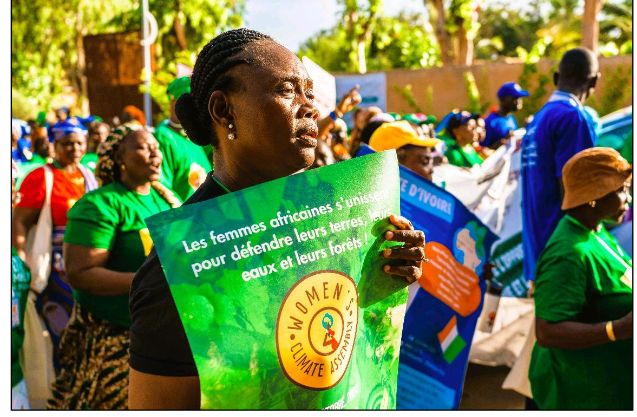
More than 75 women community leaders, activists, civil society organisations and allies from across West and Central Africa are expected to converge on Yaoundé, Cameroon, from October 5 to 8, 2026, for the fourth regional Women’s Climate Assembly (WCA).
The assembly, themed “Our Lands, Our Voices: African Women United for Climate Justice and Reparations!”, is aimed at strengthening a Pan-African ecofeminist movement for climate justice and amplifying the voices of women at the forefront of environmental and climate struggles.
Participants are expected from Burkina Faso, Cameroon, Côte d’Ivoire, the Democratic Republic of Congo, Guinea-Conakry, Liberia, Nigeria, Sierra Leone and Senegal.
The organisers said the assembly would focus on climate justice, defence of the commons, women’s leadership, food sovereignty, sustainable resource management and demands for climate reparations.
They noted that although Africa contributes minimally to global greenhouse gas emissions, its communities, particularly women in rural, coastal and forest areas, continue to experience disproportionate impacts from climate change.
According to the organisers, African women are increasingly confronted with land degradation, droughts, extreme weather events, resource conflicts and the expansion of extractive industries, including oil and gas and critical minerals.
They cited the World Meteorological Organisation’s State of the Climate in Africa 2025, which reported that climate- and weather-related hazards affected at least 13 million people and caused more than 3,000 reported deaths across Africa in 2025.
The assembly will therefore advance calls for climate reparations, with participants expected to demand increased resources for loss and damage, climate adaptation, ecosystem restoration and community-led alternatives.
The organisers said such reparations should go beyond promises of future aid to include sustained resources and greater accountability from countries and corporations responsible for historical and ongoing emissions.
The WCA is co-hosted by Green Development Advocates, WoMin African Alliance and other partners.
A statement by the organisers said the gathering would build on previous assemblies held in Nigeria and Senegal, providing a platform for women on the front lines of climate and environmental struggles to share experiences, develop strategies and strengthen solidarity.
According to the statement, the 2026 edition seeks to transform the WCA into a permanent platform operating at local, national, sub-regional and Pan-African levels.
Key sessions will examine the impact of the climate crisis in Africa, women-led resistance and alternatives, national and sub-regional assembly processes, and strategies for strengthening women’s participation in climate decision-making.
Thematic workshops will focus on the defence of the Congo Basin forests, food sovereignty and seed protection, feminist advocacy for climate justice, climate debt and reparations, as well as oil and gas expansion.
Popular education sessions will also cover seed conservation, mangrove management, processing of natural products and preservation of traditional ecological knowledge.
Speaking ahead of the assembly, Bela Marie Victorine of Cameroon said the gathering would provide an opportunity for women from other countries to experience the realities of Cameroonian women affected by major development projects and learn how they overcome the challenges.
Similarly, Abbie Freeman of Liberia said the assembly would enable her to share her community’s experiences and learn from other African women.
“I believe our voices and lived experiences must be part of climate decisions. I am here to connect, learn, and strengthen our collective voice for our land, livelihoods, and future,” she said.
The organisers described the 2026 assembly as a significant milestone in the development of an African women-led climate justice movement, particularly in amplifying the concerns of community women whose voices are often excluded from national and global climate discussions.